



1.png)
Challenging the Status Quo: Perspectives from the Indonesian Campus Workers’ Union
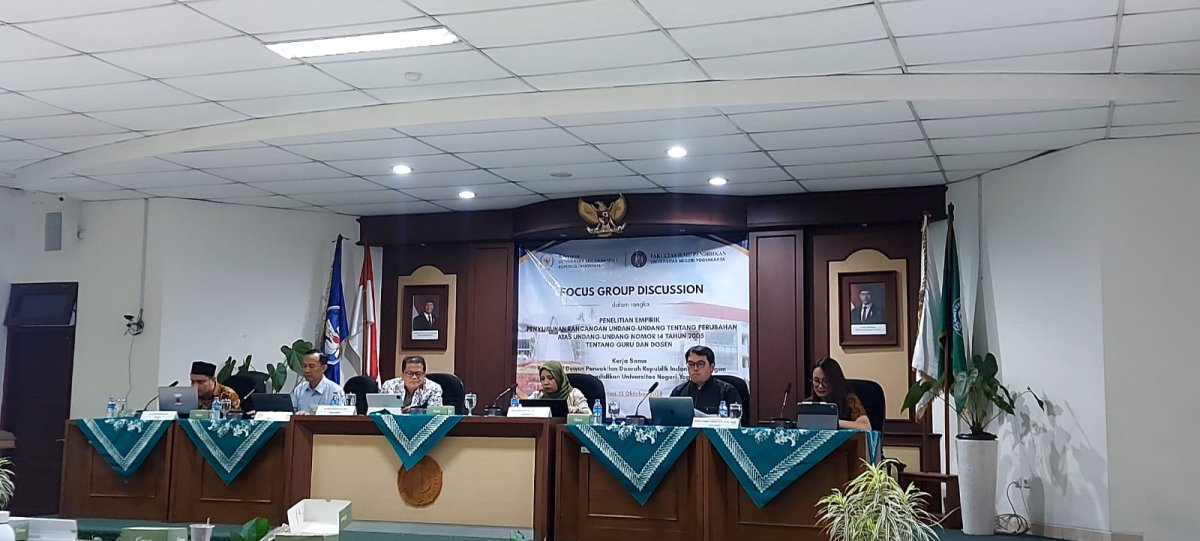
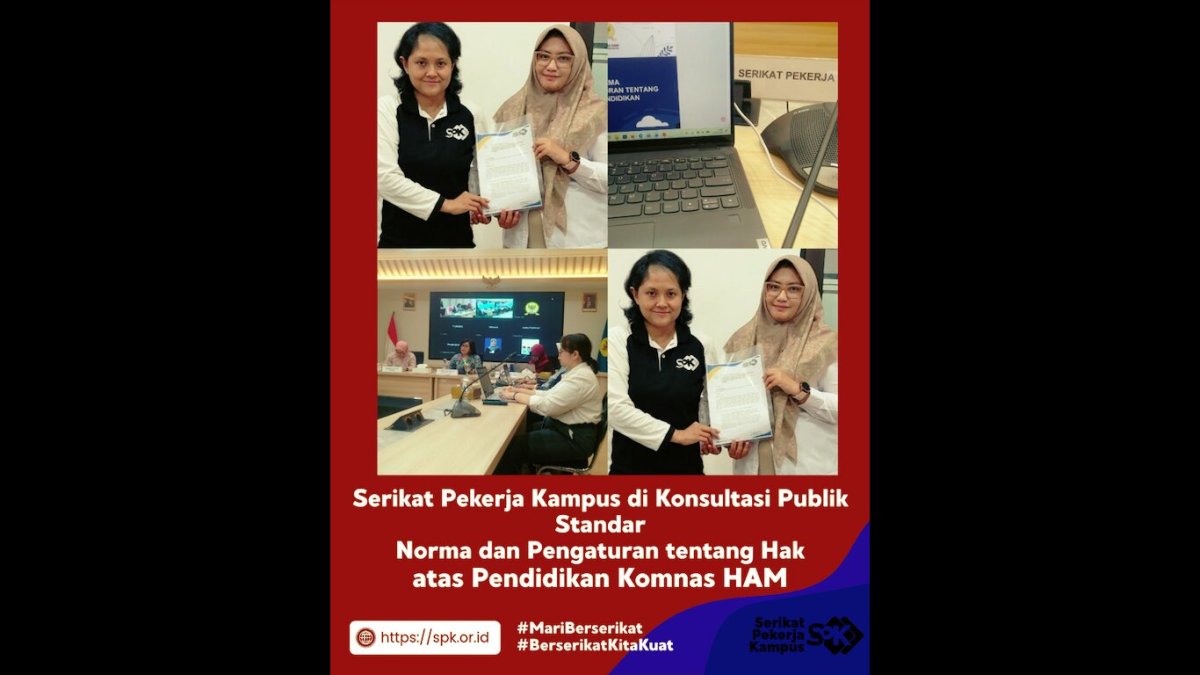
Rafiqa Qurrata A’yun dan Yesaya Sandang, perwakilan Serikat Pekerja Kampus di jaringan Scholars at Risk, menuliskan refleksi tentang pengorganisasian kekuatan pekerja kampus di Indonesia serta penguatan solidaritas internasional.
Tulisan ini dapat diakses melalui tautan:
https://www.scholarsatrisk.org/2026/07/challenging-the-status-quo-perspectives-from-the-indonesian-campus-workers-union/
The work of protecting those who think, teach, research, and care for institutions of learning is never finished. It is, however, always worth continuing.
During the 25th anniversary year of Scholars at Risk (SAR), the Indonesian Campus Workers’ Union (Serikat Pekerja Kampus/SPK) expresses its gratitude for its membership in the SAR network. Through this extensive network, SPK, in solidarity with the international scholarly community, strengthens its efforts to advocate for and campaign for academic freedom.
Established on August 17, 2023, SPK serves as a unified voice for over 2,050 permanent and casual higher education workers—including lecturers, researchers, and administrative staff—across public and private universities throughout Indonesia. We are dedicated to driving substantial change by protecting labor rights, advancing academic freedom, and improving welfare and working conditions across the sector.
For us, promoting academic freedom is central to our mission, as it is directly intertwined with the rights of university workers. We advocate for a safe environment where both academic and non-academic staff can fulfill their roles without interference or fear of retaliation. To bring this mission to life on the ground, our organizational structure utilizes seven specialized departments and localized branch networks spanning 13 regions.
The Anatomy of Threat: Bureaucratic Obstacles and Military Presence
The establishment of SPK was a direct response to a worrying domestic landscape, where threats to academic workers vary from restrictive laws and regulations to criminal charges and career obstacles. Our organisation believes that advancing academic freedom starts with the guarantee of basic labor rights and welfare. Without fair wages or decent working conditions, campus workers’ freedom of speech and academic freedom are severely limited. It is difficult to find the room to speak up or resist when one is struggling to meet basic survival needs. When advocating for welfare issues, our members face multidirectional threats from state institutions, university management, and powerful external actors.
In Indonesia – the third-largest democracy in the world, which has experienced heightened authoritarian tendencies – defending workers’ rights is increasingly challenging amid a fractured legal system and a declining democratic space. Broadly, the exercise of academic freedom has been increasingly impeded in recent years. State policies have grown more restrictive, and higher education has seen a surge in military interference. This influence manifests through formal university-military cooperation, military participation in student orientation activities, and the placement of active military personnel into roles within academic institutions. This interference is designed to contain higher education institutions, substantially undermining their institutional autonomy.
Expanding Advocacy: From the Courts to Grassroots Organizing
Despite these escalating challenges, we continue to strengthen our organisation’s stance by increasing our membership and enhancing our operational capacity. SPK’s communications department drives vital awareness campaigns; our education department conducts member training, and our regional branches actively monitor local threats. Crucially, we build alliances with Indonesian civil society movements to ensure that the fight for freedom is not an abstract concept but a daily, collective effort rooted in solidarity. This approach emphasizes a core truth: freedom is not a gift granted by the state or guaranteed by law, but a right actively reclaimed through struggle.
Recently, acute welfare concerns have taken center stage in our research and among our members, prompting SPK to shift from case-by-case advocacy toward broader structural reforms. Backed by these findings, we petitioned the Indonesian Constitutional Court regarding Law Number 14 of 2005 on Teachers and Lecturers, requesting a legal interpretation of the term “salary” to formally include lecturers at both public and private universities. Our goal is to establish a clear, humane wage standard for all university staff, challenging a status quo that our research shows falls well below a decent standard of living and directly contradicts our constitutional rights.
Nevertheless, we view legal advocacy as just one component of a progressive movement. As emphasized in our member education efforts, building a union means focusing on associational strength to achieve collective victories. SPK is primarily a tool for struggle, designed to foster political awareness and solidarity at the core of our daily work.
Solidarity beyond borders: Connecting Jakarta to Paris
“Solidarity, at its core, is the discipline of remaining attentive to one another’s struggles, even when there is no immediate reciprocity to offer.”
International solidarity is not a symbolic gesture for SPK, but a practical necessity. Threats to academic freedom and workers’ rights do not stop at national borders, and neither should our response. Through networks like SAR and regional partners such as the Southeast Asia Coalition for Academic Freedom (SEACAF), we connect with organisations facing similar struggles in varying contexts. SEACAF’s support for our efforts to advance fair compensation for Indonesian lecturers affirms that this is not merely a domestic labor issue, but a structural challenge with regional consequences on the quality and equity of higher education. This shared logic drives our solidarity outward. For instance, when library workers at the Muséum national d’Histoire naturelle in Paris mobilized against sub-minimum wages and conditions that erode institutional memory, we recognized the pattern immediately. SPK endorsed and circulated their petition because the struggle of knowledge workers to secure decent pay is universal, regardless of the distance between Jakarta and Paris. Despite differences in resources and jurisdiction, our cross-border coordination achieves vital outcomes: we share documentation to make global patterns visible, amplify external campaigns, and build deep transnational trust. Solidarity, at its core, is the discipline of remaining attentive to one another’s struggles, even when there is no immediate reciprocity to offer.
The Long Work: Sustaining the Collective Movement
“We know that structural change is slow, that legal battles are tedious, and that the erosion of academic freedom rarely announces itself with clarity.”
SPK stands at a challenging moment in Indonesian higher education, but we do not stand alone. Supported by a growing domestic membership, expanding civil society alliances, and meaningful international partnerships, we carry our work forward with both resolve and humility.
We know that structural change is slow, that legal battles are tedious, and that the erosion of academic freedom rarely announces itself with clarity. But we also know that unions are built precisely for this kind of long work—the kind that requires sustained collective effort rather than singular moments of courage. As we mark SAR’s 25th anniversary, we reaffirm our commitment to this effort and extend our deepest gratitude to all who stand alongside us. The work of protecting those who think, teach, research, and care for institutions of learning is never finished. It is, however, always worth continuing.


Komentar (0)
Belum ada komentar. Jadilah yang pertama berkomentar!